
A new client contacted us asking for "…advice on updating the website with an emphasis on SEO." My first impression of the front end was surprisingly positive considering it was built by a busy attorney. The layout and organization looked simple but nice (no blinking red text or tiled backgrounds!) But when we evaluated the back-end, we quickly found a few important issues that had to be addressed.
{edsnewanimate|class="eds-animate edsanimate-sis-hidden "|data-eds-entry-animation="fadeIn"|data-eds-entry-delay="0"|data-eds-entry-duration="0.5"|data-eds-entry-timing="linear"|data-eds-exit-animation=""|data-eds-exit-delay=""|data-eds-exit-duration=""|data-eds-exit-timing=""|data-eds-repeat-count="1"|data-eds-keep="yes"|data-eds-animate-on="scroll"|data-eds-scroll-offset="75"}
Issue 1, text formatting
{/edsnewanimate}
The attorney used H3 headline tags on some paragraph text to make it look bigger.
Online website builders are nice tools if you're on a budget and need a simple website. But as with most lower-cost options, they can have significant downsides. The text editors look a lot like what you'd see in MS Word or any other document app. Need to make the text bigger? Format the body text as headline text! As long as the text looks good on the front end there's no problem, right?
But alas, there is a problem. Google robots scan websites and they see a page that has bonkers formatting. To the search bot, All of the text is headline text and there's no body text and that does not make sense. The Google bot expects to see a hierarchy, starting with main headlines, then subheadings, then body text, and so on. Google penalizes sites for bad structure. The attorney did nothing wrong and there was no way for him to know that the site was being punished.
We made simple changes to the tags and style sheet, and voila, the issue is fixed. This is called Technical SEO, which refers to optimizing the backend structure of a website to improve its visibility and crawlability for search engines. Technical SEO also includes improving website architecture, ensuring website speed and security, and implementing schema markup.
You can see the results in the screen shot below showing the technical SEO improved the page load speeds. Home page loading scores improved from 49% to 84% in Google's PageSpeed Insights. Page load times are an important part of overall SEO, and this is a huge difference.
{edsnewanimate|class="eds-animate edsanimate-sis-hidden "|data-eds-entry-animation="fadeIn"|data-eds-entry-delay="0"|data-eds-entry-duration="0.5"|data-eds-entry-timing="linear"|data-eds-exit-animation=""|data-eds-exit-delay=""|data-eds-exit-duration=""|data-eds-exit-timing=""|data-eds-repeat-count="1"|data-eds-keep="yes"|data-eds-animate-on="scroll"|data-eds-scroll-offset="75"} {/edsnewanimate}
Issue 2: No on-page SEO
On-page SEO refers to optimizing the content and HTML source code of individual web pages to rank higher and earn more relevant traffic from search engines. This includes optimizing page titles, meta descriptions, header tags, and internal linking structure. We added a free extension to the website that allowed us to populate the on-page SEO for each page.
Both on-page SEO and technical SEO work together to improve a website's overall search engine visibility and to drive more organic traffic. Although they're invisible to the user, they're highly visible to the Google bot.
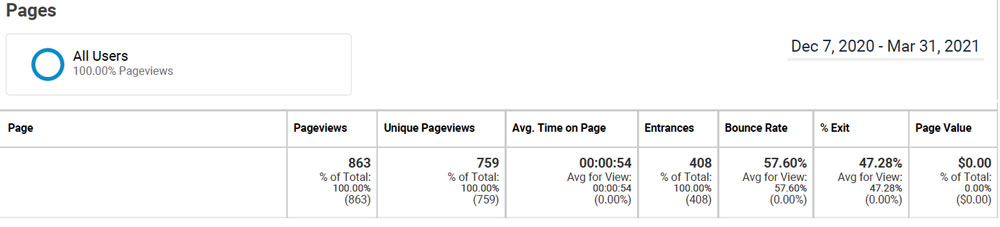
Screenshot from Google Analytics, 12/7/20 - 3/31/21
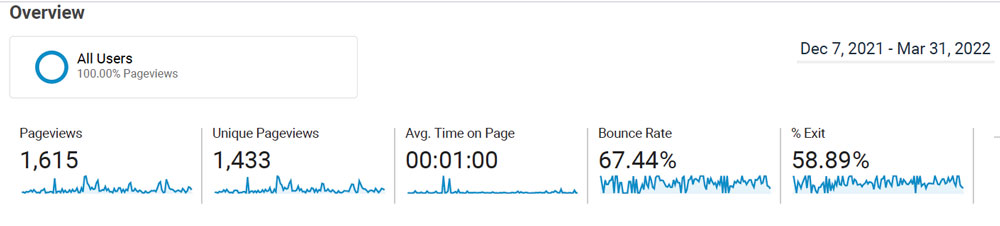
Screenshot from Google Analytics, 12/7/21 - 3/31/22